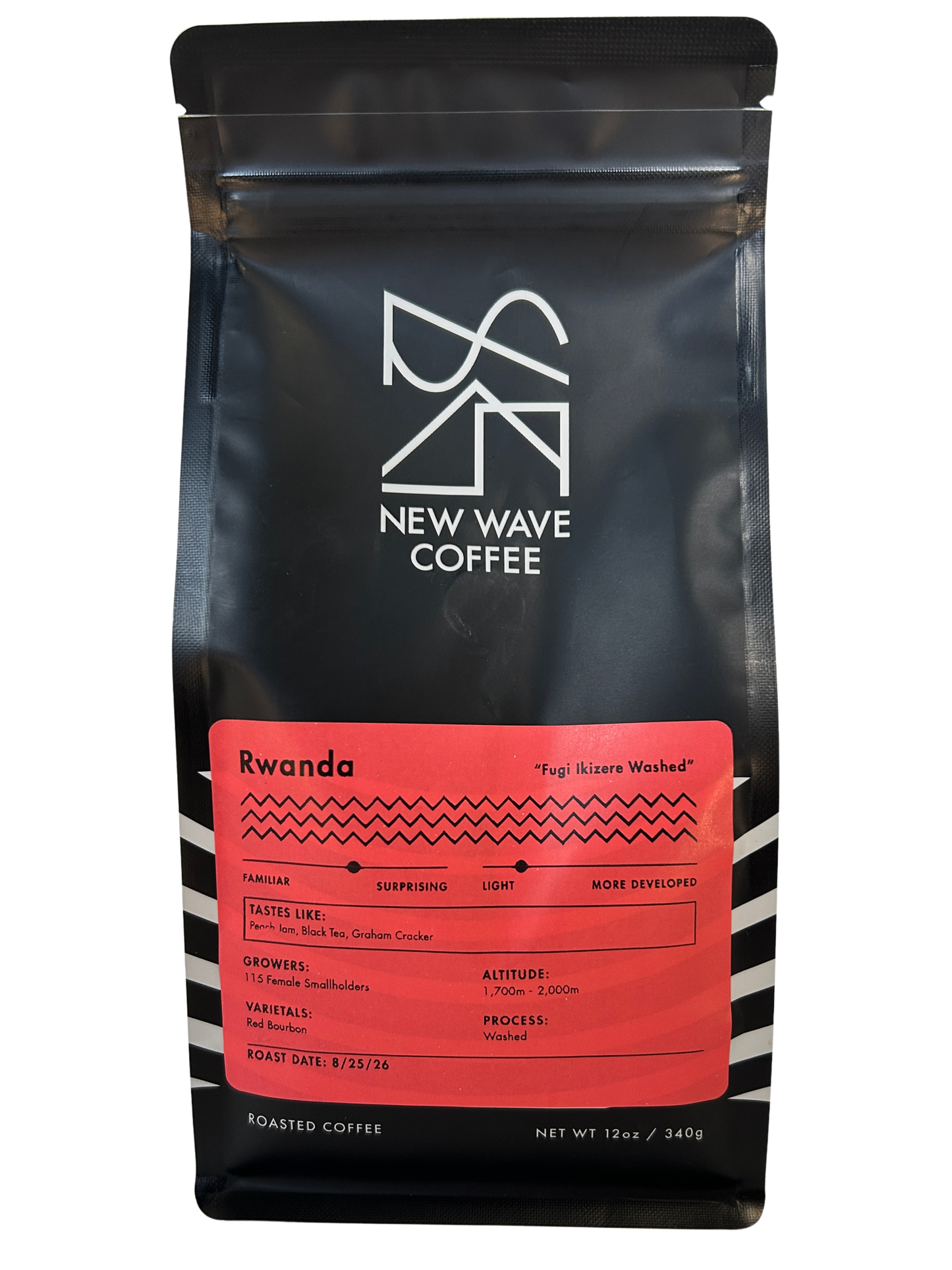

New Wave Coffee
Rwanda Fugi Ikizere Washed
Rwanda Fugi Ikizere Washed
Regular price
$20.00 USD
Regular price
Sale price
$20.00 USD
Unit price
per
Shipping calculated at checkout.
Couldn't load pickup availability
Example label zoomed in:

PRODUCER(s):
115 smallholders
STATION: Fugi
LOCATION: Nyaruguru District, Southern Province
HARVEST: April - June
ALTITUDE: 1700 - 2000 masl
VARIETY: Red Bourbon
PROCESS: Washed
STATION OWNER: Baho Coffee / Emmanuel Rusatira
STATION MANAGER: Aphrodise Munyangaju
STATION MANAGER: Aphrodise Munyangaju
# YEARS MANAGING: 8
EXPORTER: Baho Coffee / Emmanuel Rusatira
IMPORTER: Sundog Trading
AVERAGE FARM SIZE: 0.23 hectares
AVERAGE AGE OF TREES: 23 years old
EXPECTED VOLUME, per tree: 2.9 kg cherry
EXPECTED VOLUME, annually per farm: 1350 kg cherry
From Sundog Trading:
"PRICING
- Rwanda national farmgate price for cherry - 600 rwf/kg
- Baho farmgate price for cherry - 760 rwf/kg + 150 rwf/kg second payment
- FOT price, paid directly to Baho Coffee - $4.31 usd/lb
- FOB price, including transportation to port of export - $4.41 usd/lb
- We purchase coffees from Baho on an FOT basis, meaning that responsibility for the coffee transfers to us when it’s loaded onto a container in Kigali, Rwanda. We are then responsible for freight and any additional costs associated with moving that container to the port of Mombasa, Kenya, or Dar es Salaam, Tanzania, and then shipping to the US. The FOB price listed here is to provide a theoretical reference point to better compare against the majority of price transparency reporting.
- Emmanuel estimates that the current average conversion rate from cherry to green coffee is around 16% for all quality grades. However, the conversion rate for the highest scoring specialty coffees which we purchase is closer to 10-15%! This means that after the many rounds of cherry and parchment sorting, 100 kg of cherry only yields around 10 - 15 kg of specialty green coffee. We feel that this is a very relevant point to consider when comparing coffee prices across different production models in different countries. In the case of Rwanda, the washing station is largely responsible for the costs associated with production and plays a massive role in adding value.
FUGI STATION
Located in the Southern Province of Rwanda, Fugi is nestled between the Nyungwe National Forest and the border of Burundi. It quickly became established as a favorite of ours in the Baho network, producing consistently excellent washed, natural, and experimentally processed lots. In recent years Fugi has transformed into what Emmanuel has called Baho’s hub for innovation, with now over 50% of Fugi’s production dedicated to honey, natural, and anaerobic style processing. Fugi has additionally served as homebase for numerous pilot projects - like the first women producer group, a parabolic drying structure, and a small composting facility producing organic fertilizers.
Fugi was built in 2013, but it was purchased by Emmanuel in 2016. Since then, he’s dedicated this station to solely producing specialty grade coffee. Fugi was Emmanuel’s very first station; and thus, it’s a key component of the foundation upon which Baho Coffee was built. It’s the third smallest station in the Baho collection, purchasing cherry from around 950 smallholder farmers and producing 900 bags of exportable green coffee each year.
As is standard practice for Baho-owned stations - training, inputs , and substantial contributions towards health insurance premiums are provided for all farmers delivering. Furthermore, each station has an agronomist on site that organizes training sessions focused on topics such as coffee plant care (planting, fertilizing, pruning, harvesting, etc), environmental protection, and importance of our traceability efforts. Various inputs like fertilizers and new coffee seedlings are provided free of cost to all farmers. Baho is involved a step further here as well - helping farmers with transportation to gather materials and lending tools/equipment when necessary.
IKIZERE WOMEN
Emmanuel presented to us a handful of lots in 2019 that were traced back to communities surrounding specific hills. This initiative immediately sparked our interest and kickstarted our discussions on how we could expand and deepen this type of traceability. As buyers, it’s always exciting to find more information about where coffee is coming from; but additionally, Emmanuel made it very clear that it was helpful to Baho and their producer network as well. It created the opportunity to directly support producers and hopefully motivate them to continue in specialty.
Meaning confidence in Kinyarwanda, Ikizere is the name chosen by this original group of women at the Fugi station to represent Baho’s flagship initiative of traceable lot separations. It’s a project that we’re incredibly thrilled to be able to support and offer to the North American market, now for the fifth consecutive season. Though the group was originally composed solely of widows and single mothers, it has expanded in recent years to also include a handful of married women who are leading their family’s coffee production. The goals of the group remain the same - to intentionally bring together women who share the unique challenges of navigating traditionally patriarchal systems - both the Rwandese society as a whole and more specifically coffee production. Through supporting the Ikizere project, we hope to promote powerful women thriving in their communities and share a platform upon which their voices can be internationally heard.
Over the past few years, we’ve seen the Ikizere project grow quickly from just around 20 growers at the Fugi station to now 100+ women with representation at each station that we’re purchasing from. Baho is heavily investing in support for this group via access to financial education, providing short term loans, and establishing clean water lines in specific communities. Emmanuel plays an active role here by arranging meetings each season to discuss their needs beyond coffee. Nonetheless, because of the success of the program, they’re all making significant improvements to their farms and investing in growing their operations. In addition to planting new coffee seedlings, many are strategically planting shade trees and using compost fertilizers as well.
In Emmanuel’s words:
Ikizere women coffee is composed by women of same identity (single mothers and heads of families). The reasons to be single mothers are different but all people in this category face many social and economic challenges due to the traditional perceptions.
We decided to bring these women together, through coffee, and revive their hope by showing them that we consider them as part of the community and they are equally needed , important, and valued like any other person, regardless of the struggle, social & economic situation. It is a group that started in 2020, now well organized and have their elected leadership to coordinate activities. Recognition was one step, but we also want to advocate for them and sell their coffee to buyers who care about people, humanity, and equality. Coffee from these women was prepared with expectation when women used their hands to pulp cherries instead of using the machines. With income from this coffee, Baho promised these women to receive the highest price of cherries in the country, and through support from our buyers, will pay for their health insurance.
The relationship between Ikizere Women and BAHO Coffee Co. Ltd is based on humanity, social development activities and trying to change and improve living style of this group. We have so far started by training them about coffee growing, good agricultural practices, and coffee quality handling. It is a group with high level of understanding, commitment, and determination. We are developing them to make their group one of the well known women group for high coffee quality and model coffee farms. We are doing many activities with them such as training on coffee agronomy, social responsibility , access to finance with focus on saving groups, etc. We do pay them the highest cherry price every season and we make sure they are the happiest farmers not because they are women, not because they are single mothers responsible of families, but mainly because their high commitment to deliver quality coffee to our washing station. We pay them annually health insurance 100%, we give them short term loans for family development, we gave them clean drinking water line, and we have more many ideas collected from them and we will keep advocating and supporting to significantly change their lives.
PROCESSING
Every processing style begins with a day of intensive sorting at the cherry stage, under complete shade, to ensure only the ripest are chosen and any visible defects are removed. Step two is multiple rounds of floating - filling a large container with cherries and water, discarding the less dense cherries that float to the top of the tank. The densest coffees (sinkers) are reserved to be processed as the higher grade lots, and the less dense coffees (floaters) are mixed in with the rejected cherries from the initial sorting to be processed as lower grade lots.
After enough volume has accumulated, the cherries are stored in clean plastic bags for a brief 8 hour in-cherry fermentation period before being depulped. The wet parchment then undergoes a 12 hour wet fermentation before being pushed through the grading channels. Here the coffee is rigorously washed to remove any remaining mucilage and separated by density - with the highest density lots being reserved for our selections.
The drying protocol begins by moving coffee onto shaded beds for 12 - 72 hours. This is a unique step in Rwanda, called skin drying, that has two distinct benefits. First, it sets the trajectory for the entire drying phase by initially beginning very gently and slowly under complete shade. Secondly, it allows ample time for intensive sorting while the parchment is still wet - this is important because certain defects (seeds bitten by Antestia in particular, thought to cause the potato defect) can be seen much more easily when the parchment is wet.
The parchment is finally moved into semi-shaded raised drying beds within a parabolic drying structure. The roof of this greenhouse-like structure is made of semi-transparent plastic material to gently diffuse the sunlight, and the sides are made from mesh netting to allow for ample airflow. Weather conditions are closely monitored throughout the day, and if certain temperature thresholds are exceeded, workers will focus on turning coffee more frequently or move to a cooler location within the greenhouse. When moisture content reaches the target of below 11%, the drying phase is considered complete. The parchment is bagged, labelled, and stored in a dry warehouse at Fugi until time for milling. Total drying time for this lot was 28 days.
ADDITIONAL PAYMENTS
The Rwanda National Agricultural Export Board (NAEB) sets a nationally mandated farmgate price for cherry each year, with the goal of reducing predatory buying practices. This has undoubtedly increased wages for the majority of farmers across the country, but it hinders some station owners by also creating a price ceiling in an attempt to establish market parity. Emmanuel specifically experienced crossing this line in 2018, when he received a letter from the government demanding that he lower prices or else be fined. We’ve learned over the past years that getting more money into the hands of farmers isn’t quite as simple as raising cherry prices at the station.
Baho has adopted a second payment system as a workaround to this issue. We’re hoping to provide more consistency to this system by setting aside specific amounts of money each season to pay Baho’s producer partners more and more. The increased level of traceability that Baho has been able to achieve is making this process much easier, as we can now begin with dedicated small groups to implement the program. We’ve started small as we explore the best methods of dispersing payments like this fairly, but we hope to scale everything up as we grow together in the future and continue to explore Rwandese farmers’ costs of living.
We entered a unique era post-pandemic where increased market demand led to a countrywide spike in prices and extreme competition amongst stations to collect cherries. Unfortunately, this trend isn’t showing any signs of slowing down in the near future, as prices have continued to jump significantly each season. To fulfill their contracts, commodity focused stations have been paying at levels above the national average for any quality level. This means Baho has had to continuously (a) increase prices as high as possible to remain competitive and (b) start accepting more of a variety of cherry ripeness levels. It’s become commonplace that a much higher percentage of cherry than usual - up to 50% in some cases - must be sorted out to achieve their ripeness standards. He’s seen this put a massive strain on the workforce at washing stations; and because of these factors, all Baho has started incorporating additional bonuses at the end of the season for their station management staff.
These issues are continuously evolving and are accompanied by equally shapeshifting solutions. The answers are never one size fits all; and thus, we will always work closely with Emmanuel to strengthen our partnership and support in the specific areas where we’re most needed at any given time."